9  People Are Different

Modified

April 26, 2026

Run the full pipeline on both subjects and compare. With N = 2 we cannot draw population conclusions, but we can check whether our two subjects fall in the range reported by the largest published SSVEP-BCI demographics study, Guger et al. (2012).

9.1 Setup

The pipeline of the last six chapters wrapped into a function: load → filter → epoch. We call it once per .mat file and run the FBCCA classifier from Ch 6 across truncated epoch lengths.

Code
from pathlib import Path
import numpy as np
import scipy.io
import matplotlib.pyplot as plt
from scipy.signal import butter, filtfilt, iirnotch
from sklearn.cross_decomposition import CCA

DATA_DIR = Path("data")
STIM_FREQS = [9, 10, 12, 15]
N_HARMONICS = 2
SUB_BANDS = [(6, 14), (14, 22), (22, 30), (30, 40)]
WINDOW_LENGTHS = np.arange(1.0, 7.5, 0.5)


def make_filters(fs, low=5.0, high=40.0, line=50.0, order=4, notch_q=30):
    bp_b, bp_a = butter(order, [low, high], btype="band", fs=fs)
    n_b, n_a = iirnotch(line, notch_q, fs=fs)
    return (bp_b, bp_a), (n_b, n_a)


def find_trials(y):
    ch10 = y[9].astype(int)
    active = (ch10 != 0).astype(int)
    diff = np.diff(active)
    starts = np.where(diff == 1)[0] + 1
    ends = np.where(diff == -1)[0] + 1
    return [(int(s), int(e), int(ch10[s])) for s, e in zip(starts, ends)]


def load_session(path):
    mat = scipy.io.loadmat(path)
    fs = int(mat["fs"][0, 0])
    y = mat["y"]
    bp, notch = make_filters(fs)
    y_filt = y.astype(float).copy()
    for ci in range(1, 9):
        y_filt[ci] = filtfilt(*notch, filtfilt(*bp, y[ci]))
    trials = find_trials(y)
    n_samples = trials[0][1] - trials[0][0]
    epochs = np.stack([y_filt[1:9, s:s + n_samples] for s, _, _ in trials])
    labels = np.array([fr for _, _, fr in trials])
    return epochs, labels, fs


def build_template(freq, n_samples, fs, n_harmonics=N_HARMONICS):
    t = np.arange(n_samples) / fs
    refs = []
    for h in range(1, n_harmonics + 1):
        refs.append(np.sin(2 * np.pi * h * freq * t))
        refs.append(np.cos(2 * np.pi * h * freq * t))
    return np.stack(refs, axis=1)


def cca_score(X, Y):
    cca = CCA(n_components=1, max_iter=500)
    cca.fit(X, Y)
    Xc, Yc = cca.transform(X, Y)
    return float(np.corrcoef(Xc.ravel(), Yc.ravel())[0, 1])


def fbcca_predict(epoch, fs, sub_bands=SUB_BANDS, a=1.25, b=0.25):
    n = epoch.shape[1]
    weights = np.array([(i + 1) ** -a + b for i in range(len(sub_bands))])
    band_signals = []
    for low, high in sub_bands:
        b_, a_ = butter(4, [low, high], btype="band", fs=fs)
        band_signals.append(filtfilt(b_, a_, epoch, axis=-1))
    scores = np.zeros(len(STIM_FREQS))
    for fi, freq in enumerate(STIM_FREQS):
        Y = build_template(freq, n, fs, N_HARMONICS)
        for bi, sig in enumerate(band_signals):
            scores[fi] += weights[bi] * cca_score(sig.T, Y) ** 2
    return STIM_FREQS[int(np.argmax(scores))]


def wolpaw_itr(p, N, T):
    p = np.asarray(p, dtype=float)
    bits = np.zeros_like(p)
    middle = (p > 1.0 / N) & (p < 1.0)
    bits[p >= 1.0] = np.log2(N)
    bits[middle] = (np.log2(N) + p[middle] * np.log2(p[middle])
                    + (1 - p[middle]) * np.log2((1 - p[middle]) / (N - 1)))
    return bits * 60.0 / T


def sweep(epochs, labels, fs, lengths):
    accs = []
    for L in lengths:
        n_L = int(L * fs)
        truncated = epochs[:, :, :n_L]
        preds = np.array([fbcca_predict(ep, fs) for ep in truncated])
        accs.append((preds == labels).mean())
    return np.array(accs)


SESSIONS = [
    ("S1 run 1", "subject_1_fvep_led_training_1.mat", "C0", "-"),
    ("S1 run 2", "subject_1_fvep_led_training_2.mat", "C0", "--"),
    ("S2 run 1", "subject_2_fvep_led_training_1.mat", "C1", "-"),
    ("S2 run 2", "subject_2_fvep_led_training_2.mat", "C1", "--"),
]

results = []
for name, fname, color, ls in SESSIONS:
    epochs, labels, fs = load_session(DATA_DIR / fname)
    accs = sweep(epochs, labels, fs, WINDOW_LENGTHS)
    itrs = wolpaw_itr(accs, N=4, T=WINDOW_LENGTHS)
    results.append({"name": name, "accs": accs, "itrs": itrs, "color": color, "ls": ls})
    print(f"  {name:<10} done — peak acc {accs.max():.0%}, peak ITR {itrs.max():.1f} bits/min")
  S1 run 1   done — peak acc 95%, peak ITR 41.2 bits/min
  S1 run 2   done — peak acc 100%, peak ITR 41.2 bits/min
  S2 run 1   done — peak acc 80%, peak ITR 20.4 bits/min
  S2 run 2   done — peak acc 95%, peak ITR 15.1 bits/min

9.2 Accuracy and ITR side by side

Code
fig, axes = plt.subplots(1, 2, figsize=(14, 4.8))

for r in results:
    axes[0].plot(WINDOW_LENGTHS, r["accs"], r["ls"], color=r["color"],
                 marker="o", lw=1.5, label=r["name"])
    axes[1].plot(WINDOW_LENGTHS, r["itrs"], r["ls"], color=r["color"],
                 marker="o", lw=1.5, label=r["name"])

axes[0].axhline(0.25, color="C3", ls=":", alpha=0.5, label="chance (25 %)")
axes[0].set_xlabel("Epoch length (s)")
axes[0].set_ylabel("Accuracy")
axes[0].set_ylim(0, 1.05)
axes[0].set_title("Accuracy")
axes[0].legend()
axes[0].grid(alpha=0.3)

axes[1].set_xlabel("Epoch length (s)")
axes[1].set_ylabel("ITR (bits/min)")
axes[1].set_title("Information Transfer Rate")
axes[1].legend()
axes[1].grid(alpha=0.3)

fig.tight_layout()
fig.savefig("images/09-subjects_comparison.png", dpi=200, bbox_inches="tight")
plt.show()
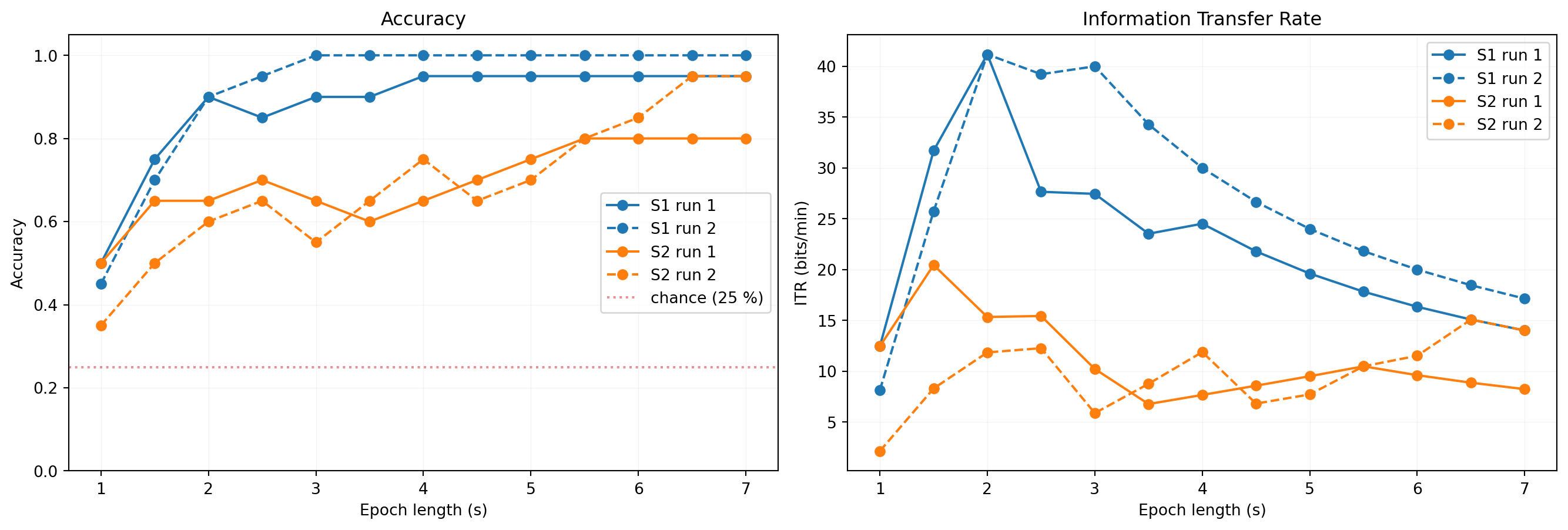
Figure 9.1: Accuracy (left) and ITR (right) vs epoch length, for all four sessions. Subject 1 in blue, subject 2 in orange; solid = run 1, dashed = run 2.

The two subjects clearly separate. Subject 1 reaches ~90 % accuracy by 2 s and stays there; subject 2 needs the full 7-second epoch to come close. The ITR curves invert this nicely: subject 1’s peak sits in the 1.5–2.5 s range and is much taller (the user can take a decision every second or two with high confidence), while subject 2’s curve is flatter and lower.

This is the opposite of the ranking we’d guess from Ch 1. Back there, we picked subject 2 run 2 as the “running example” because it had the cleanest CH11 LDA output. CH11 turned out to be a poor proxy for what our own classifier could extract — subject 1’s CCA-friendly signal beats subject 2’s visually-clean baseline. The lesson: don’t let the shipped baseline pick your favourite subject.

9.3 Peak performance per session

Code
print(f"{'session':<10}  {'peak acc':<9}  {'@ T (s)':<9}  {'peak ITR':<10}  {'@ T (s)':<9}")
print(f"{'-' * 10}  {'-' * 9}  {'-' * 9}  {'-' * 10}  {'-' * 9}")
for r in results:
    i_acc = int(np.argmax(r["accs"]))
    i_itr = int(np.argmax(r["itrs"]))
    print(f"{r['name']:<10}  {r['accs'][i_acc]:<9.0%}  {WINDOW_LENGTHS[i_acc]:<9.1f}  "
          f"{r['itrs'][i_itr]:<10.1f}  {WINDOW_LENGTHS[i_itr]:<9.1f}")
session     peak acc   @ T (s)    peak ITR    @ T (s)  
----------  ---------  ---------  ----------  ---------
S1 run 1    95%        4.0        41.2        2.0      
S1 run 2    100%       3.0        41.2        2.0      
S2 run 1    80%        5.5        20.4        1.5      
S2 run 2    95%        6.5        15.1        6.5      

The columns matter together. Looking at peak accuracy alone, all four sessions clear 80 %, which would suggest “everyone is fine”. But peak ITR exposes the gap: subject 1’s ITR roughly doubles subject 2’s. Using accuracy as the ranking metric hides the fact that the two subjects are operating at very different bandwidth tiers.

9.4 Where do our subjects sit in the literature?

The largest published demographics study for this exact setup — 4-class LED-flicker SSVEP with 8 occipital channels — is Guger et al. (2012), with 53 subjects. Their headline numbers:

  • Mean accuracy: 95.5 % across the population.
  • 96.2 % of subjects scored above 80 % accuracy.
  • No subject scored below 60 %.

That last figure is the striking one. Other BCI paradigms (motor imagery, P300) routinely have a “BCI illiteracy” tail of users who can’t drive the system above chance. SSVEP doesn’t have that tail — the response is automatic, requires no mental strategy, and works for almost everyone with intact vision.

Our N = 2 fits inside that distribution. Both subjects clear 80 % at the full epoch (subject 1 hits 100 % on run 2; subject 2 reaches 95 % on run 2). Subject 2’s run 1 caps at 80 %, which would have placed them at the 96th-percentile floor of Guger et al. (2012). Nothing pathological, just on the harder end.

We can’t say more than that. With two subjects we can verify “we look like we belong in the published distribution”; we cannot estimate the distribution itself, predict where a new subject would land, or claim our pipeline outperforms anyone else’s. The right shape of evidence for those questions is multi-site, pre-registered, with the sample size needed to bound the metric of interest — not a thoughtful re-analysis of one dataset.

9.5 What N = 2 can’t tell us

Things this analysis cannot answer, ordered by how often they get answered anyway:

  • Population accuracy. Any number we report (mean, peak, peak ITR) on N = 2 is anecdote. Confidence intervals on a two-subject mean are wider than the dataset’s full range.
  • Which classifier is “best”. CCA / FBCCA dominated CH11 here, but on subject 1 plain CCA already saturates at 100 %; FBCCA’s contribution can’t be measured. A larger sample would show whether the FBCCA gain is real or a single-trial fluke.
  • What predicts a “good” subject. Maybe alpha amplitude, electrode contact quality, attention, age, eye dominance, time-of-day. We have no leverage on any of this with two people.
  • Within-subject day-to-day stability. Each subject did two runs, recorded back-to-back; the variability we see is between-runs-within-session, not across genuine sessions on different days. The latter is what BCI deployment cares about.

The honest summary: this dataset is large enough to develop and verify a pipeline (which is what the rest of the book did), and small enough that any quantitative claim about “users in general” requires a different study to justify. SSVEP’s robust population profile, established by Guger et al. (2012) and confirmed in subsequent multi-site studies, is the reason a competition or product can ship with this paradigm without much per-user calibration — but the evidence for that reliability lives in those larger studies, not here.