Develop a visual intuition for the SSVEP response — first as a pattern across electrodes, then as a peak in the spectrum, then as four distinguishable peaks across the four stimulation classes. Purely exploratory: no preprocessing, no features, no classifier yet.
2.1 A note on the example file
The book’s running example is subject_2_fvep_led_training_2.mat — the cleanest of the four sessions for downstream work. This chapter is the one exception: it uses subject_1_fvep_led_training_1.mat instead, and it’s worth saying why.
The four stimulation frequencies (9, 10, 12, 15 Hz) overlap with the alpha rhythm (8–12 Hz), a strong natural occipital oscillation that’s there whether or not the LED is flickering. In raw, unfiltered PSDs that means the peak we want to see (the SSVEP at the stimulation frequency) competes with the peak we don’t (alpha at ~10 Hz). On the running file, alpha wins on most classes — the 12 Hz class on Oz, for example, has alpha twice as tall as the stimulation peak. A “see the SSVEP peak” demo on that file would mostly show alpha.
subject_1_fvep_led_training_1.mat shows the SSVEP rising above alpha on Oz for every class, so the raw-data demos work visually. The file does have the broken LDA (CH11 stuck on class 3) flagged in Ch 1 — irrelevant here, since this chapter doesn’t use CH11. The running example resumes from Ch 3 onward, once filtering takes alpha out of the picture.
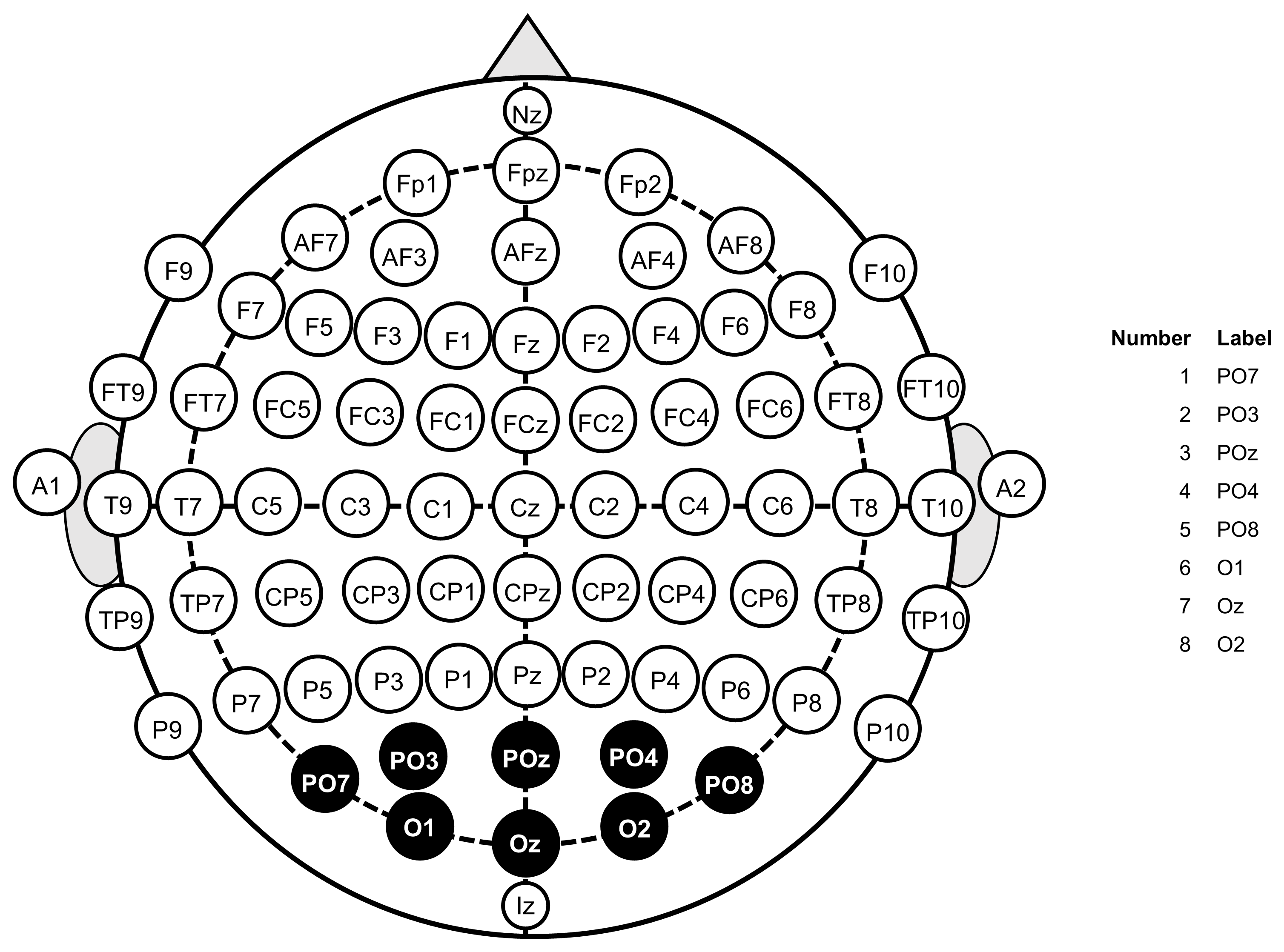
The eight EEG channels split into two rows over visual cortex (V1/V2): the PO sites (PO7, PO3, POz, PO4, PO8) sit on the parieto-occipital boundary, and the O sites (O1, Oz, O2) sit purely over occipital cortex below them. SSVEP is generated here because that’s where flicker-driven oscillations originate — the montage is purpose-built for SSVEP, not a generic EEG cap.
2.3 The signal across the 8 occipital electrodes
Code
from pathlib import Pathimport numpy as npimport scipy.ioimport matplotlib.pyplot as pltfrom scipy.signal import welchDATA_DIR = Path("data")EEG_LABELS = ["PO7", "PO3", "POz", "PO4", "PO8", "O1", "Oz", "O2"]OZ =7# zero-indexed: y[7] is CH8 = Ozmat = scipy.io.loadmat(DATA_DIR /"subject_1_fvep_led_training_1.mat")fs =int(mat["fs"][0, 0])y = mat["y"]def find_trials(y):"""Return [(start_idx, end_idx, freq_hz), ...] from CH10 transitions.""" ch10 = y[9].astype(int) active = (ch10 !=0).astype(int) diff = np.diff(active) starts = np.where(diff ==1)[0] +1 ends = np.where(diff ==-1)[0] +1return [(s, e, int(ch10[s])) for s, e inzip(starts, ends)]trials = find_trials(y)print(f"{len(trials)} trials, durations {sorted({round((e-s)/fs, 2) for s,e,_ in trials})} s")print(f"Class counts: {dict(sorted({f: sum(1for _,_,fr in trials if fr==f) for _,_,f in trials}.items()))}")
20 trials, durations [np.float64(7.36)] s
Class counts: {9: 5, 10: 5, 12: 5, 15: 5}
Each entry in trials is a (start_idx, end_idx, freq_hz) tuple. So a value like (2150, 3175, 12) means: “a trial ran from sample 2150 to sample 3175, and the LED was flashing at 12 Hz throughout.” Reading ch10[s] once at the start is enough because CH10 holds that same non-zero value steady for the entire trial — there’s no need to check every sample in between. That third field is the trial’s ground-truth label: it’s what oz_power_at_stim uses to know which frequency bin to read in the PSD, and what the per-class averaging in the next block uses to group trials.
Code
def oz_power_at_stim(trial): s, e, fr = trial ff, pxx = welch(y[OZ, s:e], fs=fs, nperseg=min(1024, e - s))return pxx[np.argmin(np.abs(ff - fr))]demo_trial =max(trials, key=oz_power_at_stim)s, e, f_hz = demo_trialprint(f"Demo trial: {f_hz} Hz, t = {s / fs:.1f}–{e / fs:.1f} s")
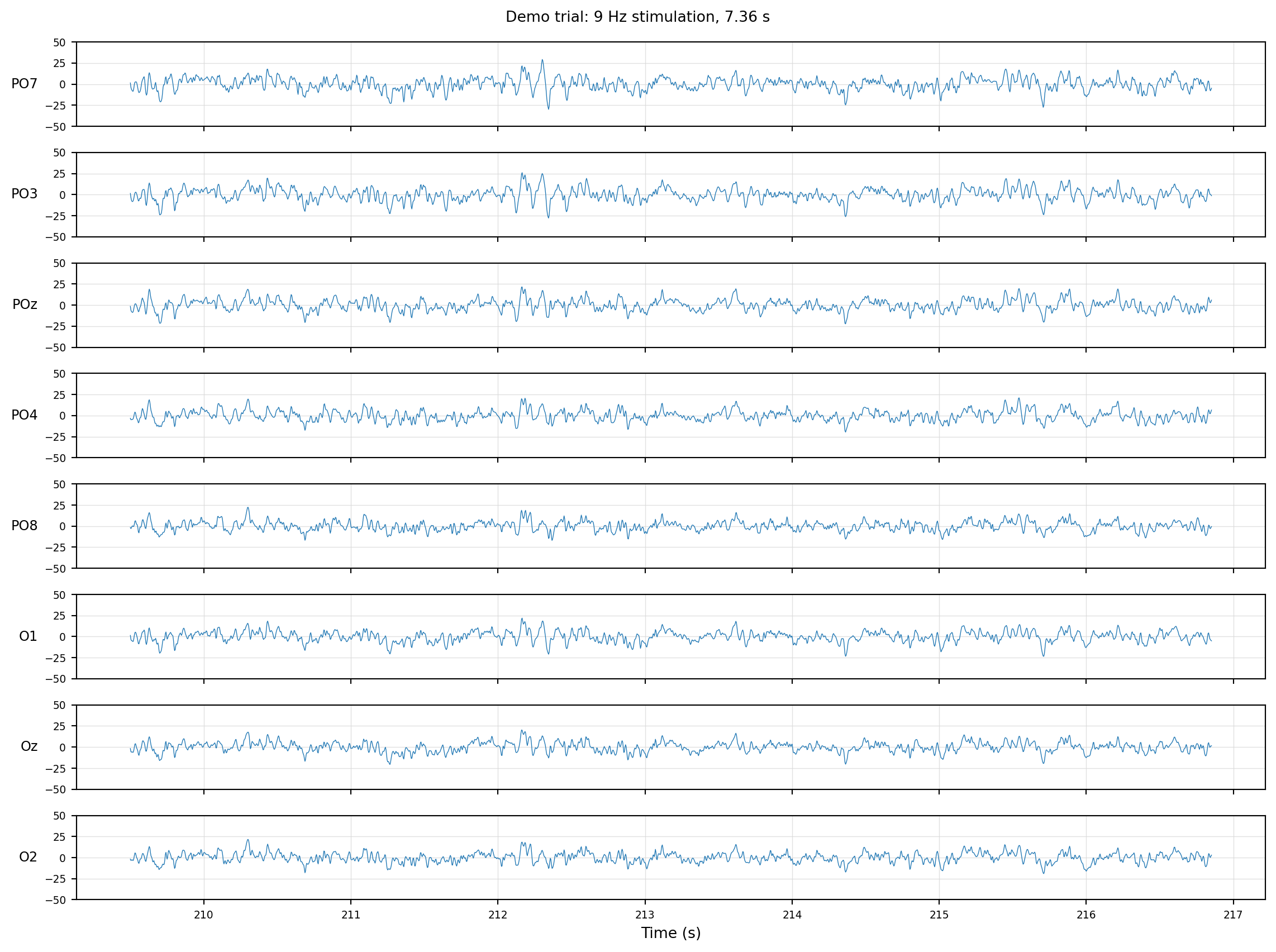
Figure 2.2: Eight occipital channels during one stimulation trial.
All eight channels show rhythmic activity during the trial — the raw EEG isn’t dramatically different from rest at a glance, but the pattern is there. The channels are clearly correlated; PO3/POz/PO4 in the middle show the largest swings. Going from time domain to frequency domain is what makes the SSVEP unmistakable — that’s the next plot.
2.4 Seeing the peak — Welch PSD on Oz
Single-trial PSDs are noisy — not every trial shows the SSVEP equally clearly. For the demos in this chapter we pick the single trial with the strongest Oz response at its stimulation frequency, so the patterns we’re trying to point at are visible. The four-classes plot below drops that crutch and averages across all five trials of each class, where the peaks emerge robustly without cherry-picking.
We use Welch’s method for the PSD: it splits the trial into overlapping segments, FFTs each one, and averages the results — trading frequency resolution for a smoother, lower-variance spectrum than a single FFT of the whole trial would give. For the single-trial demo plot we use nperseg = e - s (the whole trial as one window, ~7.5 s ≈ 1920 samples → 0.13 Hz/bin), giving the sharpest possible peak. The trial-selector and per-class averaging keep min(1024, e - s) so cross-trial bin counts stay aligned for averaging.
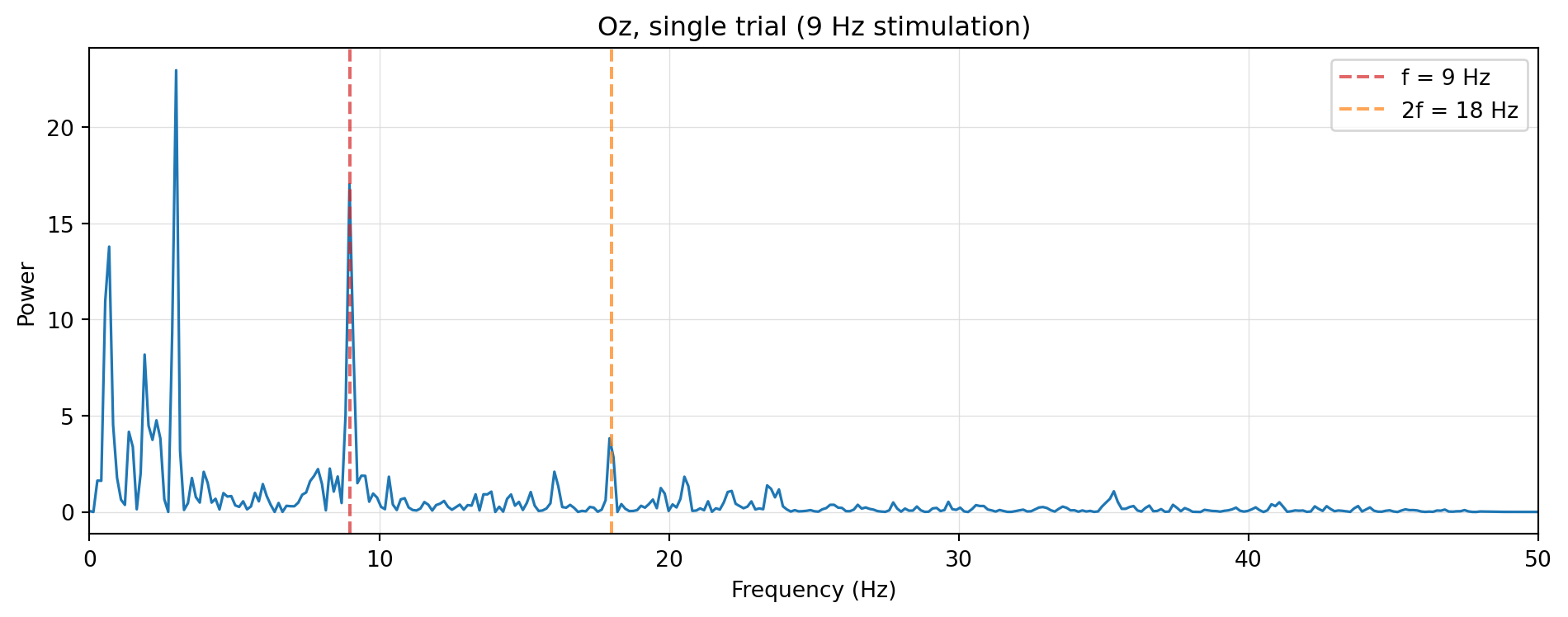
Figure 2.3: Welch PSD on Oz for the same trial. Dashed lines mark the stimulation frequency f and its second harmonic 2f.
There it is: a sharp peak at f — phase-locked, narrowband response from visual cortex to the periodic LED. The second harmonic at 2f is also visible and sometimes nearly as tall, because SSVEP responses aren’t perfectly sinusoidal — the visual cortex puts energy into harmonics too.
The other peaks aren’t SSVEP. The tall spike below 1 Hz is baseline drift — slow electrode polarization, breathing, sweat — amplified by the 1/f power law that EEG follows, which is why DC always wins on raw spectra. The bumps at 2–3 Hz are mostly eye-movement and blink artifacts capacitively coupling into the occipital electrodes; the small bump near 10 Hz is the natural alpha rhythm. All three are present in the rest period before this trial too, at similar or larger amplitude — they have nothing to do with the LED. Removing them is the job of Ch 3 (filtering); for now the point is to see what’s actually in raw data, SSVEP and noise side by side.
Without the SSVEP peak the BCI has nothing to classify — everything in later chapters is built on it.
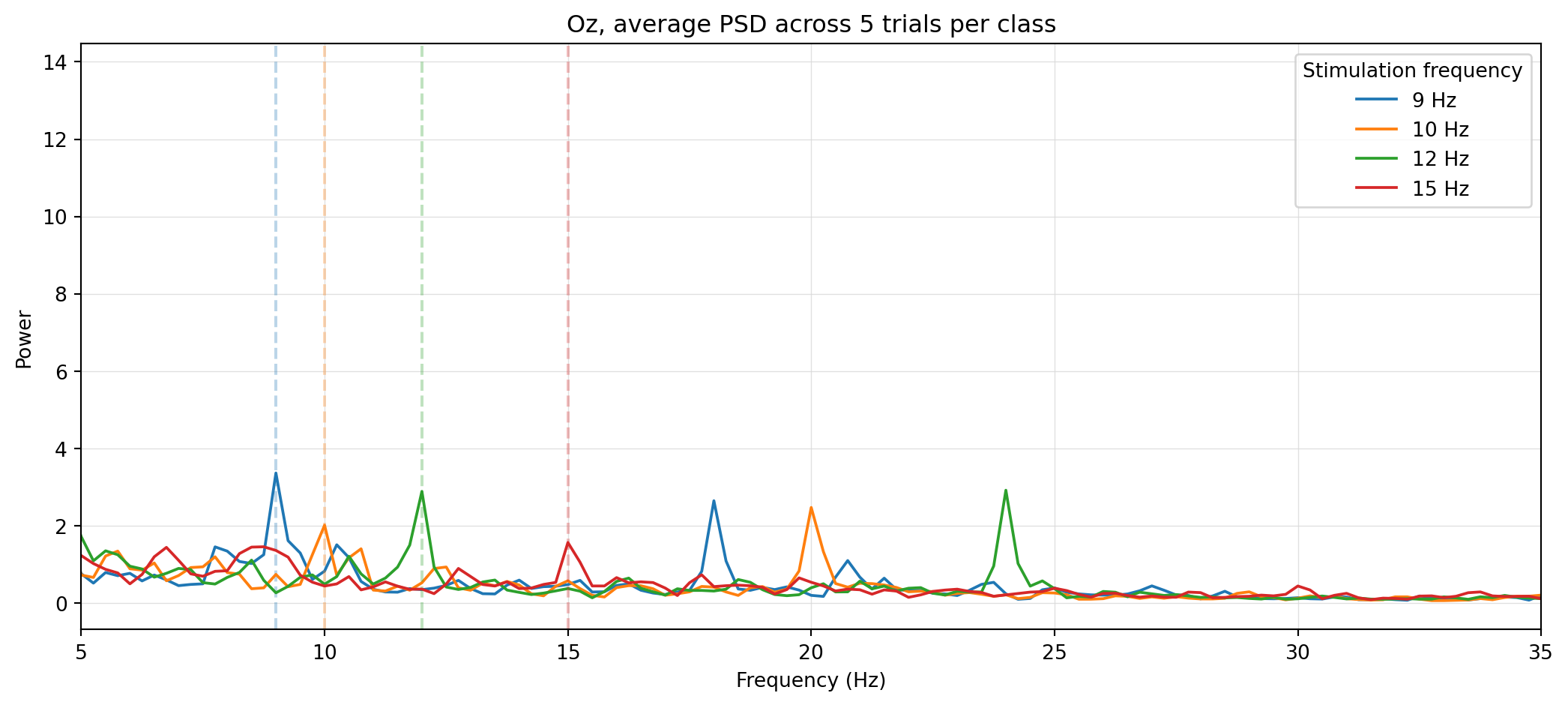
Figure 2.4: Average PSD on Oz, one curve per stimulation class. Dashed verticals mark the four stimulation frequencies.
Each class lights up where it should: 9 Hz peaks at 9, 15 Hz peaks at 15, and where the fundamental brushes alpha — 10 and 12 Hz — the second harmonic at 20 and 24 Hz takes over as the dominant feature. That’s a useful preview: a classifier doesn’t have to bet on the fundamental alone. The four frequencies were chosen so no two classes share a low-order harmonic and so the highest still leaves Nyquist headroom (fs = 256 Hz, 4× the highest stimulation frequency), which keeps the spectrum non-overlapping enough that simple peak-reading is plausible. We come back to this in Ch 5 (features) and Ch 7 (classification).