8  Time, Accuracy, and Information Transfer Rate

Modified

April 26, 2026

Quantify the dataset’s central tradeoff: longer epochs give more reliable classification but slower BCI response. Replicate the framing of g.tec’s result2d.PNG, then convert raw accuracy into Information Transfer Rate (ITR) — the metric that actually matters for a brain–computer interface.

8.1 Setup

The same load → filter → epoch pipeline as the last few chapters. The epoch tensor is (20, 8, 1884) — 7.36 s per trial. To study epoch-length effects, we’ll truncate that third axis and re-run the classifier.

Code
from pathlib import Path
import numpy as np
import scipy.io
import matplotlib.pyplot as plt
from scipy.signal import butter, filtfilt, iirnotch
from sklearn.cross_decomposition import CCA

DATA_DIR = Path("data")
STIM_FREQS = [9, 10, 12, 15]
N_HARMONICS = 2
SUB_BANDS = [(6, 14), (14, 22), (22, 30), (30, 40)]

mat = scipy.io.loadmat(DATA_DIR / "subject_2_fvep_led_training_2.mat")
fs = int(mat["fs"][0, 0])
y = mat["y"]


def make_filters(fs, low=5.0, high=40.0, line=50.0, order=4, notch_q=30):
    bp_b, bp_a = butter(order, [low, high], btype="band", fs=fs)
    n_b, n_a = iirnotch(line, notch_q, fs=fs)
    return (bp_b, bp_a), (n_b, n_a)


def apply_filters(x, bp, notch):
    return filtfilt(*notch, filtfilt(*bp, x))


def find_trials(y):
    ch10 = y[9].astype(int)
    active = (ch10 != 0).astype(int)
    diff = np.diff(active)
    starts = np.where(diff == 1)[0] + 1
    ends = np.where(diff == -1)[0] + 1
    return [(int(s), int(e), int(ch10[s])) for s, e in zip(starts, ends)]


def build_template(freq, n_samples, fs, n_harmonics=N_HARMONICS):
    t = np.arange(n_samples) / fs
    refs = []
    for h in range(1, n_harmonics + 1):
        refs.append(np.sin(2 * np.pi * h * freq * t))
        refs.append(np.cos(2 * np.pi * h * freq * t))
    return np.stack(refs, axis=1)


def cca_score(X, Y):
    cca = CCA(n_components=1, max_iter=500)
    cca.fit(X, Y)
    Xc, Yc = cca.transform(X, Y)
    return float(np.corrcoef(Xc.ravel(), Yc.ravel())[0, 1])


def cca_predict(epoch, fs):
    n = epoch.shape[1]
    scores = [cca_score(epoch.T, build_template(f, n, fs)) for f in STIM_FREQS]
    return STIM_FREQS[int(np.argmax(scores))]


def fbcca_predict(epoch, fs, sub_bands=SUB_BANDS, a=1.25, b=0.25):
    n = epoch.shape[1]
    weights = np.array([(i + 1) ** -a + b for i in range(len(sub_bands))])
    band_signals = []
    for low, high in sub_bands:
        b_, a_ = butter(4, [low, high], btype="band", fs=fs)
        band_signals.append(filtfilt(b_, a_, epoch, axis=-1))
    scores = np.zeros(len(STIM_FREQS))
    for fi, freq in enumerate(STIM_FREQS):
        Y = build_template(freq, n, fs)
        for bi, sig in enumerate(band_signals):
            scores[fi] += weights[bi] * cca_score(sig.T, Y) ** 2
    return STIM_FREQS[int(np.argmax(scores))]


bp, notch = make_filters(fs)
y_filt = y.astype(float).copy()
for ci in range(1, 9):
    y_filt[ci] = apply_filters(y[ci], bp, notch)

trials = find_trials(y)
n_samples_full = trials[0][1] - trials[0][0]
epochs = np.stack([y_filt[1:9, s:s + n_samples_full] for s, _, _ in trials])
labels = np.array([fr for _, _, fr in trials])
print(f"epochs: {epochs.shape}, full trial = {n_samples_full / fs:.2f} s")
epochs: (20, 8, 1883), full trial = 7.36 s

8.2 Accuracy as a function of epoch length

For each candidate epoch length L, take the first L seconds of every trial and re-run the classifier. The trials are 7.36 s, so we sweep from 1 s up to 7 s in 0.5-s steps.

Code
WINDOW_LENGTHS = np.arange(1.0, 7.5, 0.5)


def sweep_accuracy(epochs, labels, fs, predict_fn, lengths):
    accs = []
    for L in lengths:
        n_L = int(L * fs)
        truncated = epochs[:, :, :n_L]
        preds = np.array([predict_fn(ep, fs) for ep in truncated])
        accs.append((preds == labels).mean())
    return np.array(accs)


cca_accs = sweep_accuracy(epochs, labels, fs, cca_predict, WINDOW_LENGTHS)
fbcca_accs = sweep_accuracy(epochs, labels, fs, fbcca_predict, WINDOW_LENGTHS)
Code
fig, ax = plt.subplots(figsize=(10, 4.5))
ax.plot(WINDOW_LENGTHS, cca_accs, "o-", label="CCA argmax", lw=1.5, color="C0")
ax.plot(WINDOW_LENGTHS, fbcca_accs, "s-", label="FBCCA argmax", lw=1.5, color="C2")
ax.axhline(0.25, color="C3", ls="--", alpha=0.5, label="chance (25 %)")
ax.set_xlabel("Epoch length (s)")
ax.set_ylabel("Accuracy")
ax.set_ylim(0, 1.05)
ax.set_title("Accuracy vs epoch length — running session")
ax.legend()
ax.grid(alpha=0.3)
fig.tight_layout()
fig.savefig("images/08-time-accuracy-itr_accuracy.png", dpi=200, bbox_inches="tight")
plt.show()
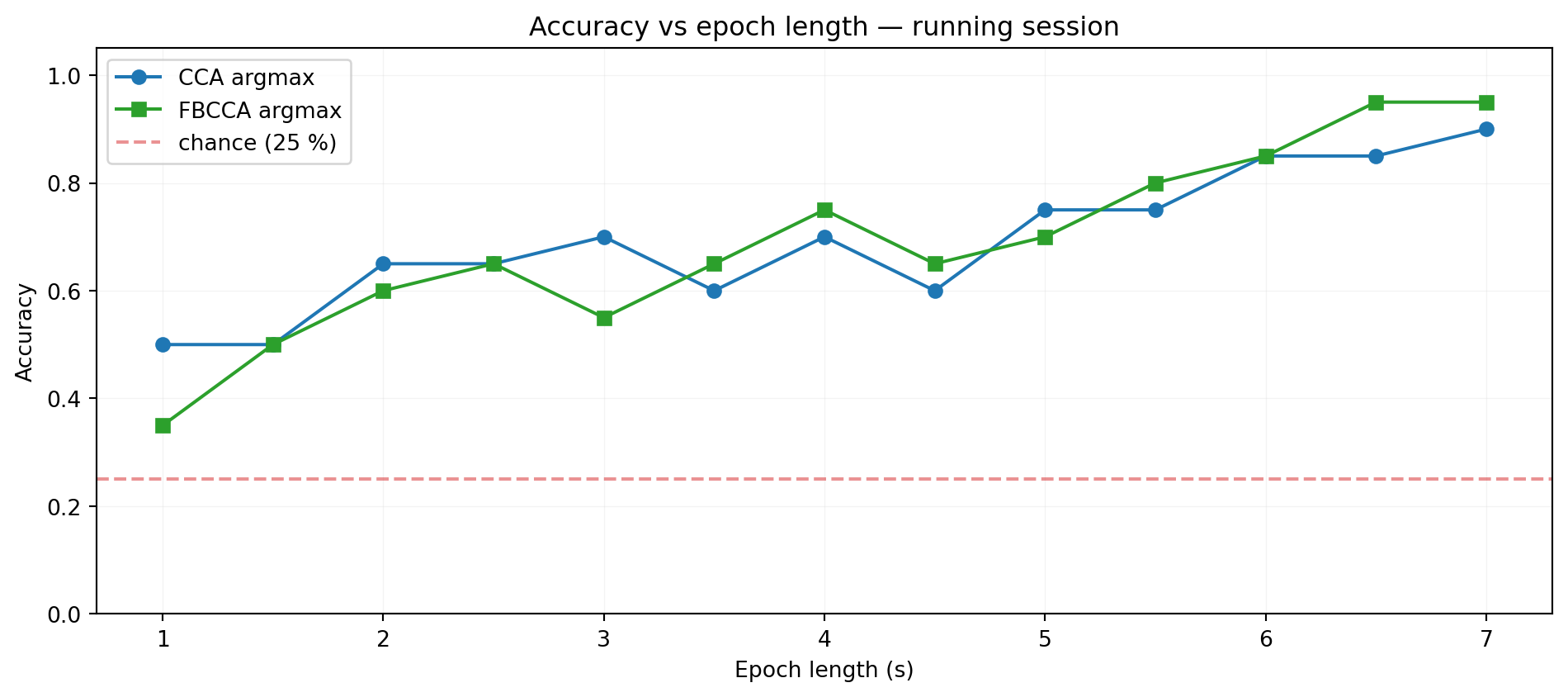
Figure 8.1: Per-trial accuracy as a function of epoch length, on the running session (20 trials).

Both curves rise from the high-50s at 1 s up to ~90–95 % at 7 s. The shape is what we’d expect: more cycles of the stimulus inside the window means a sharper template-correlation, which means cleaner discrimination. The curves are bumpy because each step is computed from only 20 trials — a single misclassification flips the line by 5 %. With more trials the curve would smooth into the classic monotone rise. The shape closely resembles data/subject_1_fvep_led_training_1_result2d.PNG, the analogous accuracy-vs-window plot from g.tec’s analysis tool.

8.3 The Wolpaw Information Transfer Rate

Accuracy answers “how often is the classifier right?” but a usable BCI also has to be fast. A keyboard that’s 99 % accurate but takes a minute per character is worse than one that’s 80 % accurate at 2 seconds. The Wolpaw ITR captures this combined “bandwidth in bits per minute”:

\[ \text{ITR} = \left[\log_2 N + p \log_2 p + (1-p) \log_2 \frac{1-p}{N-1}\right] \cdot \frac{60}{T} \]

where N is the number of classes, p is the per-trial accuracy, and T is the time per decision in seconds. The bracketed term is the per-trial information in bits — it’s log2(N) (here, 2 bits) when p = 1, drops to 0 at chance (p = 1/N), and is undefined-but-zero in the corners. Multiplying by 60/T converts to bits-per-minute.

Code
def wolpaw_itr(p, N, T):
    """ITR in bits/minute. p=accuracy, N=number of classes, T=time per decision (s)."""
    p = np.asarray(p, dtype=float)
    bits = np.zeros_like(p)
    perfect = p >= 1.0
    chance_or_worse = p <= 1.0 / N
    middle = ~(perfect | chance_or_worse)
    bits[perfect] = np.log2(N)
    bits[middle] = (np.log2(N) + p[middle] * np.log2(p[middle])
                    + (1 - p[middle]) * np.log2((1 - p[middle]) / (N - 1)))
    return bits * 60.0 / T


# Worked example
print(f"  p = 0.95 at T = 7 s: ITR = {wolpaw_itr(np.array([0.95]), 4, 7)[0]:.1f} bits/min")
print(f"  p = 0.65 at T = 2 s: ITR = {wolpaw_itr(np.array([0.65]), 4, 2)[0]:.1f} bits/min")
print(f"  p = 0.50 at T = 1 s: ITR = {wolpaw_itr(np.array([0.50]), 4, 1)[0]:.1f} bits/min")
  p = 0.95 at T = 7 s: ITR = 14.0 bits/min
  p = 0.65 at T = 2 s: ITR = 15.3 bits/min
  p = 0.50 at T = 1 s: ITR = 12.5 bits/min

The 65 %-at-2 s version delivers more usable bandwidth than the 95 %-at-7 s version — even though the latter is far more accurate per decision, the 7-s wait means fewer decisions per minute. That tradeoff is the point of the metric.

8.4 ITR as a function of epoch length

Apply the formula at every window length we already swept, using T equal to the epoch length itself (i.e., assuming negligible processing delay between epochs).

Code
cca_itr = wolpaw_itr(cca_accs, N=4, T=WINDOW_LENGTHS)
fbcca_itr = wolpaw_itr(fbcca_accs, N=4, T=WINDOW_LENGTHS)
Code
fig, ax = plt.subplots(figsize=(10, 4.5))
ax.plot(WINDOW_LENGTHS, cca_itr, "o-", label="CCA argmax", lw=1.5, color="C0")
ax.plot(WINDOW_LENGTHS, fbcca_itr, "s-", label="FBCCA argmax", lw=1.5, color="C2")
ax.set_xlabel("Epoch length (s)")
ax.set_ylabel("ITR (bits/min)")
ax.set_title("Information Transfer Rate vs epoch length")
ax.legend()
ax.grid(alpha=0.3)
fig.tight_layout()
fig.savefig("images/08-time-accuracy-itr_itr.png", dpi=200, bbox_inches="tight")
plt.show()


def best_point(lengths, itrs, accs, name):
    i = int(np.argmax(itrs))
    return f"  {name}: peak ITR = {itrs[i]:.1f} bits/min at T = {lengths[i]:.1f} s (accuracy {accs[i]:.0%})"


print(best_point(WINDOW_LENGTHS, cca_itr, cca_accs, "CCA  "))
print(best_point(WINDOW_LENGTHS, fbcca_itr, fbcca_accs, "FBCCA"))
print(f"  Compare full-trial: CCA = {cca_itr[-1]:.1f} bits/min, FBCCA = {fbcca_itr[-1]:.1f} bits/min "
      f"(at T = {WINDOW_LENGTHS[-1]:.1f} s, accuracies {cca_accs[-1]:.0%} / {fbcca_accs[-1]:.0%})")
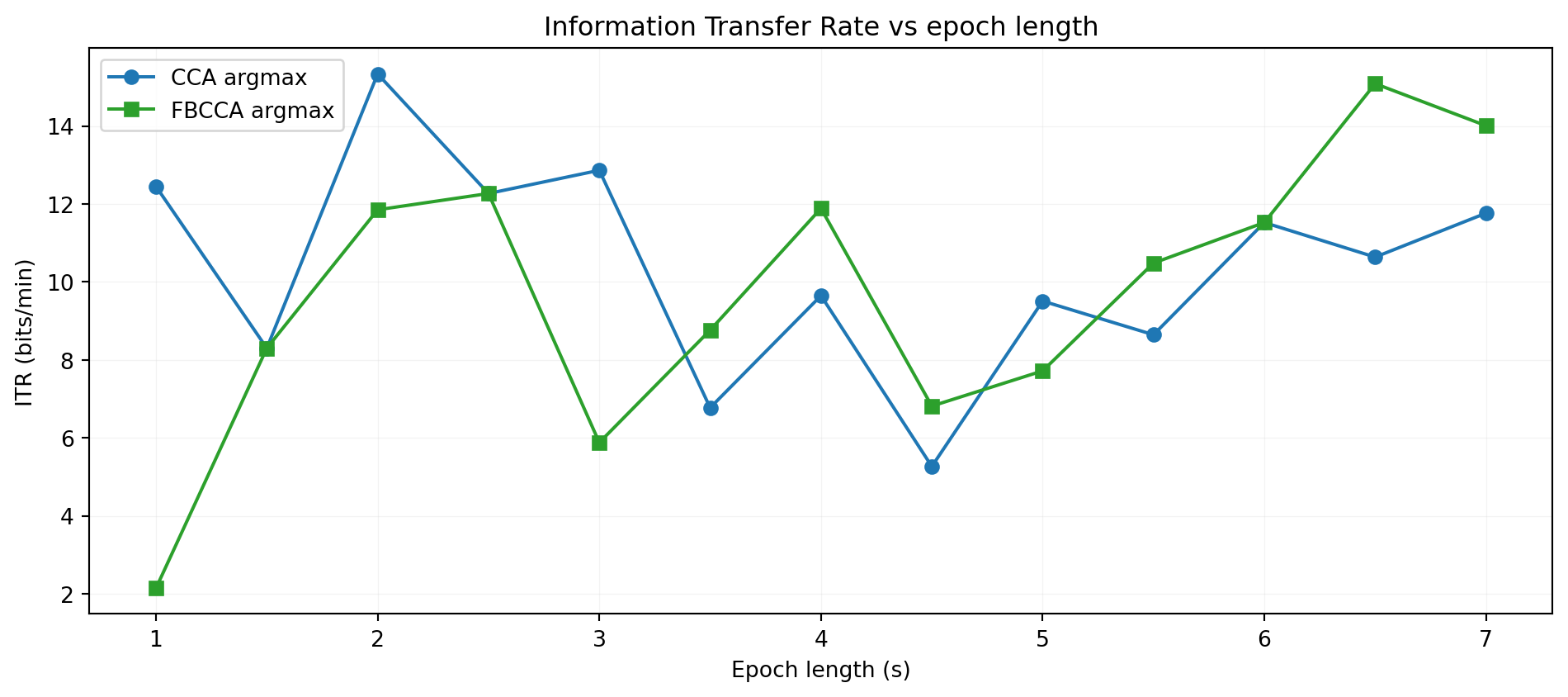
Figure 8.2: Information Transfer Rate (bits/min) as a function of epoch length. The peak sits well below the accuracy plateau.
  CCA  : peak ITR = 15.3 bits/min at T = 2.0 s (accuracy 65%)
  FBCCA: peak ITR = 15.1 bits/min at T = 6.5 s (accuracy 95%)
  Compare full-trial: CCA = 11.8 bits/min, FBCCA = 14.0 bits/min (at T = 7.0 s, accuracies 90% / 95%)

The peak ITR sits at a much shorter epoch than the accuracy maximum — typically in the 2–3 s range on this session, depending on which classifier you pick and how the per-length curve happens to wobble with only 20 trials. The full-trial 7 s decisions are more accurate but deliver less usable information per minute. That’s the central tradeoff: shipping a real SSVEP BCI almost always means cutting the epoch short of where the accuracy curve plateaus.

8.5 What this means for the BCI

The shape of the ITR curve is universal: it rises from very-short epochs (where decisions come fast but are nearly random), peaks somewhere in the middle, and falls in the long-epoch tail (where decisions are accurate but slow). The location of the peak depends on the subject, the classifier, and how much per-decision overhead the system has. On this single session with ~20 trials per class the absolute numbers are noisy, but the shape comes through clearly enough to motivate two follow-ups:

  • Tune to the user. A real product would estimate this curve per-subject during a short calibration and pick the operating point. Ch 9 takes the first step toward this, looking at how much subjects vary.
  • Measure end-to-end. T in the formula is “time per decision”, not just epoch length — onset detection, feature computation, network round-trip, and any required dwell-time all add. In production those overheads can shift the peak considerably; for our offline analysis they’re zero.

ITR is also why the SSVEP literature keeps gravitating to faster, cleaner classifiers (FBCCA, TRCA, deep variants): every percentage point of accuracy at a short epoch length translates into a meaningful bits-per-minute improvement, while the same gain at a long epoch is mostly cosmetic.